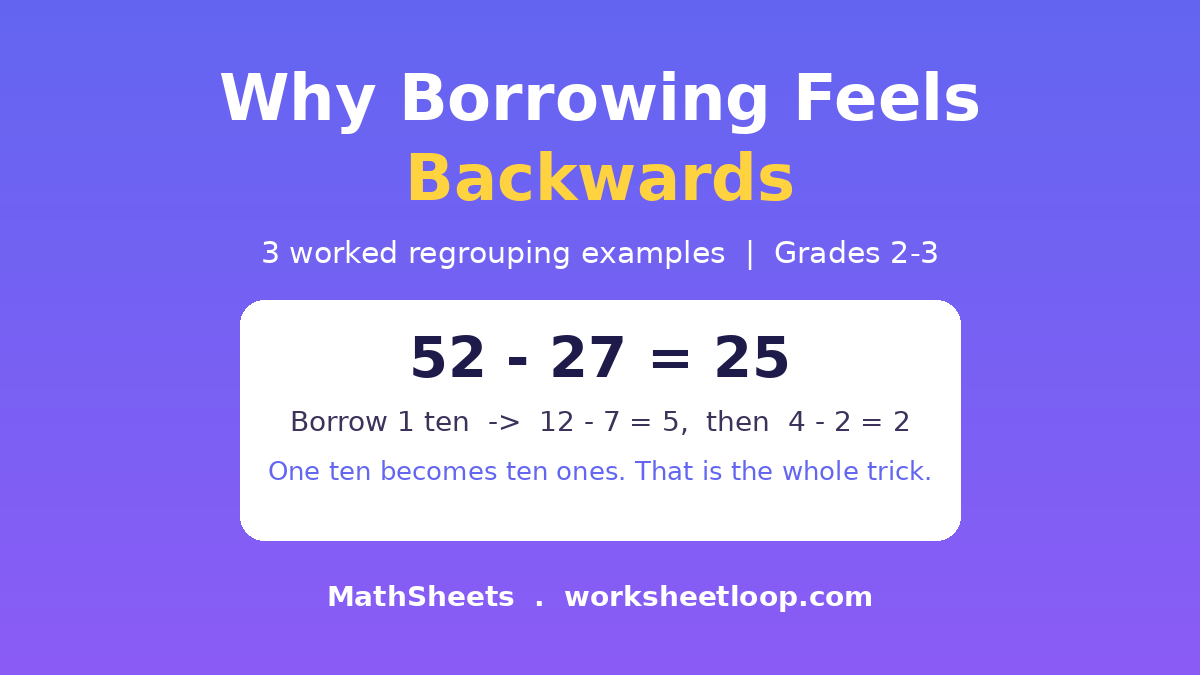
If you have ever watched a child stare at 52 − 27, you have seen the exact moment regrouping stops making sense. The child knows 2 is smaller than 7. The child also knows you cannot simply flip the numbers and do 7 − 2 instead, because the teacher said so — but nobody has explained why the rule works. So the child guesses, borrows from the wrong place, or writes down a digit that looks right and moves on.
Borrowing feels backwards because it is, in a sense, the opposite of counting up. In addition, groups get bigger. In subtraction with regrouping, a ten breaks apart into ten ones. The total does not change, but the way it is grouped does. Once a child sees that exchange clearly, borrowing stops being a magic trick and becomes a fair trade.
Try this first: generate a fresh subtraction practice sheet for grade 2, and keep it beside you while you read the examples below. The examples use the same kind of problems your child will meet on that sheet, so the practice follows the teaching instead of coming before it.
The one idea underneath every borrowing problem
Every two-digit number is really a bundle of tens and ones. The number 52 is 5 tens and 2 ones. The number 27 is 2 tens and 7 ones. Subtraction asks us to take away tens from tens and ones from ones — until the ones we need exceed the ones we have.
That is the whole problem in 52 − 27. We have only 2 ones, and we need to take away 7. The fix is not to invent ones out of nowhere. It is to trade: break one ten into ten ones. Now we have 4 tens and 12 ones, and 12 ones are plenty for taking away 7. The total is still 52. We have only regrouped it.
Say it out loud with your child: ‘One ten becomes ten ones. Nothing is added, nothing disappears.’ Children who can say that sentence can usually do the procedure, because they know what the crossed-out digit means.
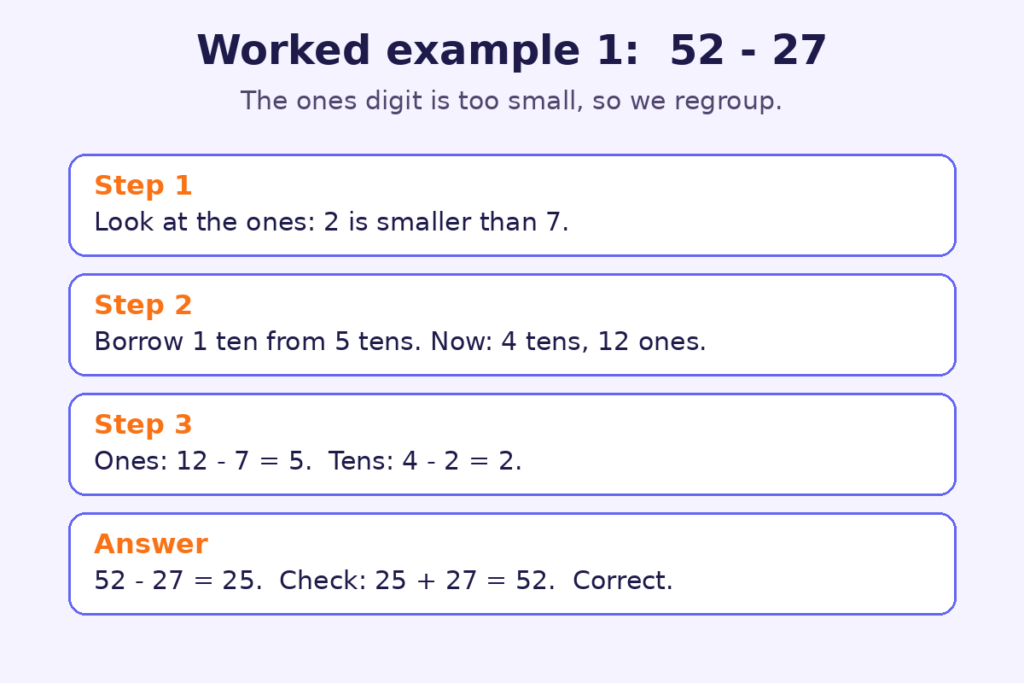
Worked example 1: 52 − 27 = 25
Start with the ones column, always from the right. The ones ask: 2 − 7. That cannot be done as it stands, so we regroup.
First, borrow 1 ten from the 5 tens. Cross out the 5 and write a small 4 above it. Add those ten ones to the 2 ones you already have, making 12 ones. Now the ones column reads 12 − 7 = 5. Write 5 in the ones place of the answer.
Next, the tens column. You now have 4 tens left, not 5, because one ten was traded away. So 4 − 2 = 2. Write 2 in the tens place. The answer is 25.
Check it by adding back: 25 + 27 = 52, the number we started with, so the answer is correct. That habit matters more than speed — a child who checks catches the most common error, forgetting that the tens digit went down by one, before it becomes a habit.
Three mistakes to watch for
Most regrouping errors are not calculation errors. They are place-value errors, and they repeat in a pattern you can spot in a minute of marking.
| Mistake | What you will see | Why it happens |
|---|---|---|
| Subtracting the smaller digit from the larger one | 52 − 27 = 35 | The child does 7 − 2 = 5 and 5 − 2 = 3, skipping regrouping entirely. |
| Forgetting to reduce the tens | 63 − 28 = 45 (correct answer: 35) | The child regroups the ones (13 − 8 = 5) but subtracts from 6 tens instead of the 5 tens left (6 − 2 = 4). |
| Crossing out without trading | Crossed-out digits that do not match any trade | The child copies the look of borrowing without the place-value exchange behind it. |
If you see the first mistake, go back to the trade: one ten for ten ones, with bundles of ten sticks if you have them. If you see the second, slow down at exactly one point — the moment after borrowing, ask ‘How many tens are left now?’ before subtracting. That single question fixes more papers than ten more problems will.
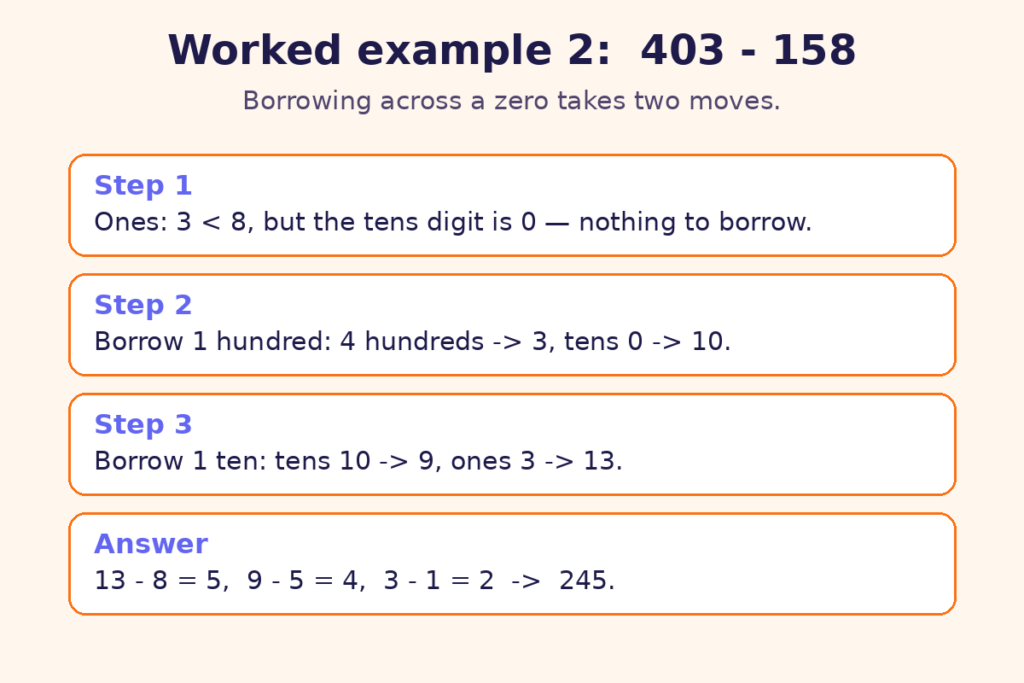
Worked example 2: borrowing across a zero — 403 − 158 = 245
Zeros make borrowing feel impossible, because there is nothing in the tens column to borrow from. The fix is a two-step trade, and it is worth teaching slowly, one trade at a time.
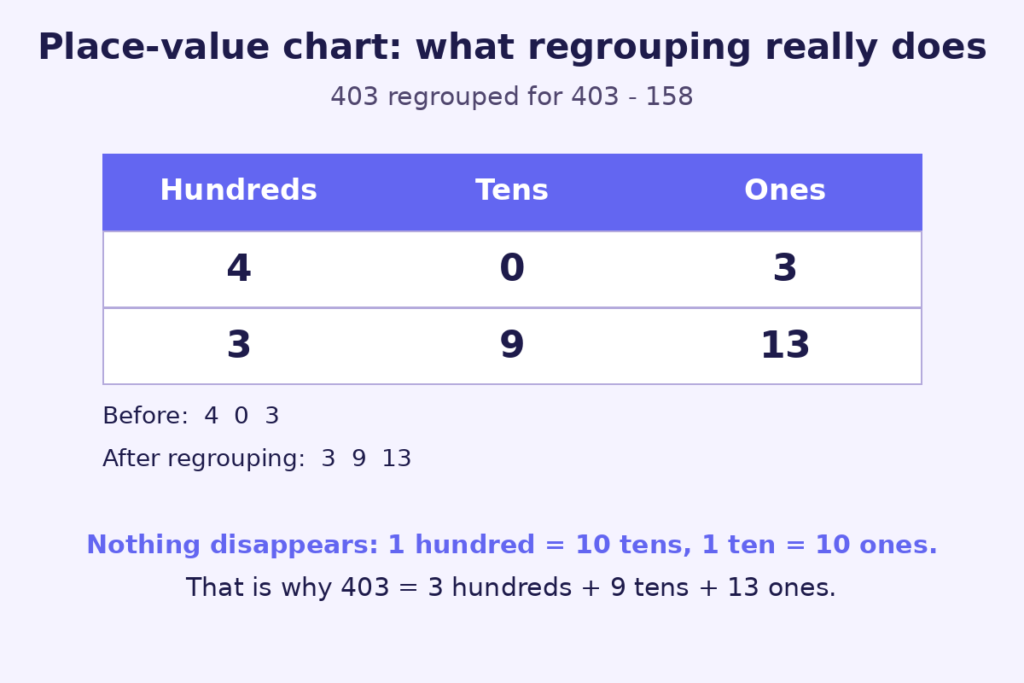
Start with the ones: 3 − 8 cannot be done, and the tens digit is 0. So first borrow from the hundreds. Take 1 hundred from the 4 hundreds, leaving 3 hundreds, and turn it into 10 tens. Now the number reads 3 hundreds, 10 tens, 3 ones.
Next, borrow 1 ten from those 10 tens, leaving 9 tens, and add ten ones to the ones column: 3 ones become 13 ones. Now subtract column by column: ones 13 − 8 = 5, tens 9 − 5 = 4, hundreds 3 − 1 = 2. The answer is 245.
Check: 245 + 158 = 403. Again, adding back proves the answer, and it also proves that the two trades did not change the total. For grade 3 practice at this level, try our grade 3 subtraction generator — it produces exactly this kind of three-digit problem, with an answer key for checking.
Worked example 3: regrouping works in addition too — 726 + 487 = 1,213
Regrouping is not only a subtraction idea. In addition, groups sometimes get too big for their column, and the extra ten trades upward instead of downward.
Add the ones: 6 + 7 = 13. That is 1 ten and 3 ones, so write 3 in the ones place and carry 1 ten. Add the tens: 2 + 8 + the carried 1 = 11. That is 1 hundred and 1 ten, so write 1 in the tens place and carry 1 hundred. Add the hundreds: 7 + 4 + the carried 1 = 12. Write 12. The answer is 1,213.
Check by place value: 726 + 487 = 700 + 400 + 20 + 80 + 6 + 7 = 1,100 + 100 + 13 = 1,213. Correct. Children who meet regrouping in both directions stop thinking of it as ‘the subtraction trick’ and start seeing it as how numbers work. For addition practice with regrouping, our grade 2 addition generator is a good next step once two-digit subtraction feels solid.
A 10-minute routine that actually sticks
First, do one problem together, out loud, naming every trade. Second, let the child do one alone, but require the check — add back for subtraction, estimate for addition. Third, generate a short sheet of five problems and mark only the regrouping step, not the final answer, so the child learns where the marks that matter are.
Ten minutes of that beats a full page of rushed, unchecked problems. If borrowing is still shaky after a week, drop back a level: the ladder matters more than the grade label on the sheet.
Frequently asked questions
Why does my child subtract the smaller number from the larger one?
Because that rule works when no regrouping is needed, and children over-apply rules that have worked before. Show the trade with objects — ten ones bundled into a ten — and the shortcut stops looking like a rule and starts looking like a guess.
Should children learn borrowing before they understand place value?
No. Place value comes first. A child who can say ’52 is 5 tens and 2 ones’ and can trade one ten for ten ones is ready. A child who only memorised the crossing-out steps will fail the first problem with a zero in it.
How much practice is enough?
Short, checked practice beats long, unchecked practice. Five problems a day, each checked by adding back, for a week, will tell you more than fifty problems done in one sitting. When the check passes without help three days in a row, move up a level.